
Pharaoh & ubCode
An agentic engineer that works according to your standards, not around them.
The agent working like your developers, according to your requirements and standards – every line of code is fully traceable and based on your intent, not just the prompt.
Trusted by industry leaders everyday











Achieve modern development speed while keeping safety-critical rigor. No trade-off needed.
When you finally get an agent that works based on your intent, the work that used to take a sprint is done in an afternoon.
Development Speed
The agent handles the mass of the coding, ensures traceability by construction, and conforms to standards – your engineers focus on the hard problems.
Trustable outputs
Every line of written code meets your standards. No late flags in compliance work, no costly rework cycles – the agent writes to the spec, not around it.
Increased impact
A team of 8 shipping like a team of 25. By construction, the agent absorbs overhead coordination efforts that safety-critical projects demand.
ubCode
Write safety-critical code as fast as you think.
ubCode is the code-authoring engine connected to the intent layer – and one of the surfaces to access the agent, Pharaoh. Every line of code you write is verified against the intent and checked for traceability in real-time as you type.
Ontology Correctness
Ensures context and ontology correctness by deafult
< 500 ms
Artifact edits appear in the traceability tree as you type
pharaoh
Delegate to an agent without worrying about the audit
Pharaoh reads deterministic context from the intent layer, so every output is traceable and conforms to your standards by construction. Work with it where you already are — IDE, CLI, or MCP — following your workflows, your rules, your review gates.
“Pharaoh seems very happy, just like me. We seem to think alike.”
Nico Hartmann
CTO @ Qorix
SphiNx-needs
The foundation – our OSS model
Sphinx-needs was the jump-off point for our toolchain. Based on the same data model we build the intent layer and every enablement that comes with it. Opening up new worlds of productivity gains.
>5.5M Downloads
The industry standard OSS model, used by +40 OEMs and T1's
+10 Years
With over 10 years experience, we know the industry by heart

Why teams use useblocks
5x
Faster requirement
linking
577
Hours saved per
developer/year
10x
Faster release
cycles
80%
Reduction in
documentation time
We'll show you what compliant agentic engineering looks like on your code
See how useblocks can boost your teams productivity - safe, reliable and trustable.
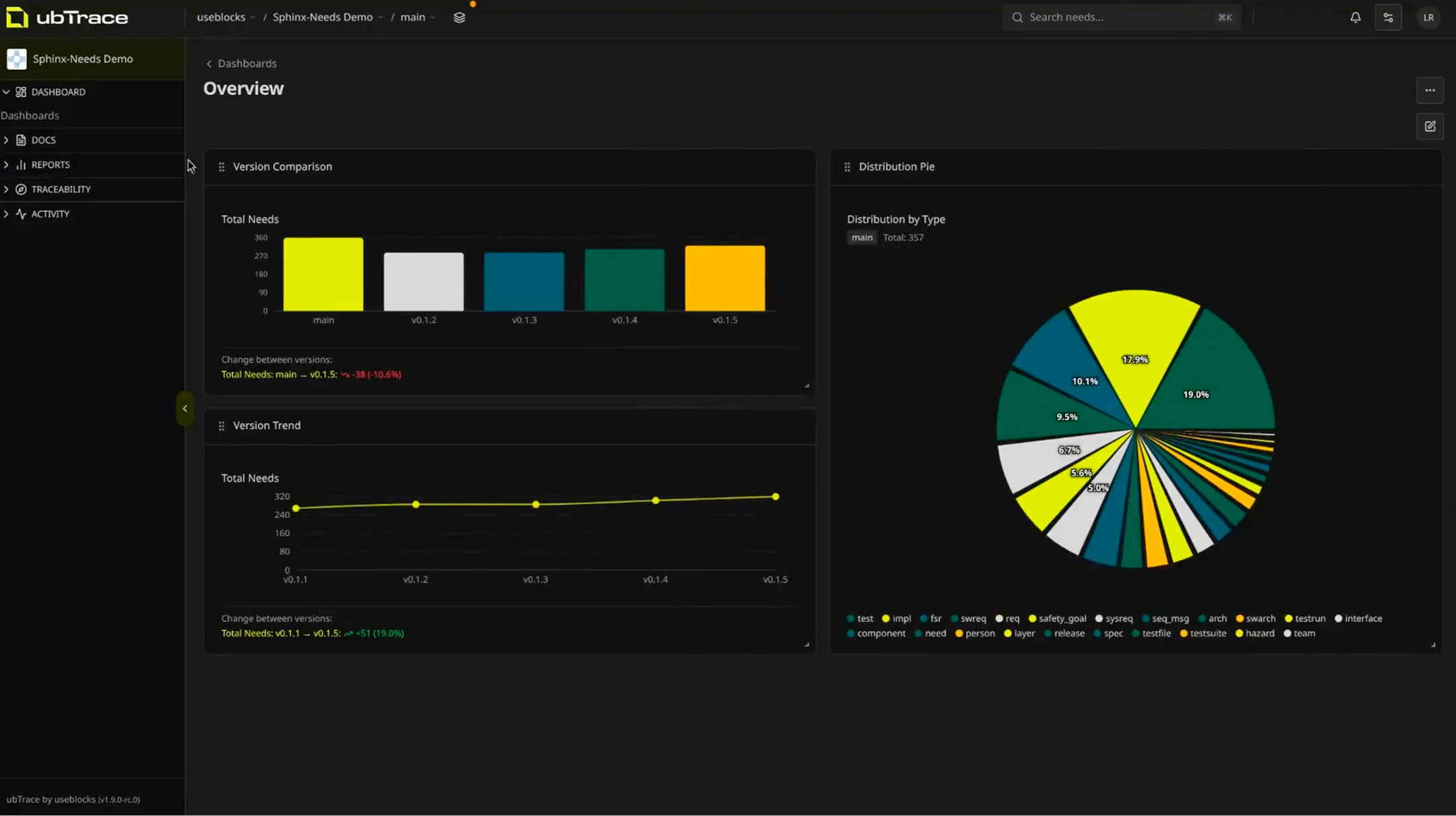
explore ubTrace
The live model of safety-critical engineering projects.
All data about your projects – structure, coverage, and risk read straight from the work. Live-generated status reports according to your standards show the true state.
Frequently asked questions
Common questions about useblocks, engineering-as-code, and how we fit into safety-critical workflows.